Monday, 15 January 2007
Madness in Mexico City
Ever since I was a boy I've dreamed of visiting the Amazon.
Some kids want to be astronauts. Some want to be firemen. But not me. I wanted to be an Indian, living deep in the Amazonian jungle with some unknown tribe, who would accept me as one of their own and teach me the ways of the forest.
I think a lot of that came from watching a film called The Emerald Forest based on the true story of a boy who was kidnapped by a Brazilian tribe.
It fascinated me then - and still does today - that there are Indians living in the Amazon who have never had contact with the outside world. Unknown tribes, who have lived in the rainforest for eons, and have never seen or spoken to a white man.
When I was twelve, I resolved to save up the money I was earning from my paper round - which was about £2.60 a week - and use it to visit the Amazon.
I guessed that it would take me about six months to save up the necessary airfare. When I arrived in the jungle, I genuinely believed that I would come across a tribe who would 'see the light of the forest in my eyes' and take me in as one of their own.
I planned to spend the rest of my days living blissfully amongst the trees, bathing in clear lakes and flirting with bare breasted young women. Yup, I was a strange kid.
Well twenty-one years later, at the grand old age of 33, I am finally on my way to the Amazon where I will spend the best part of a month living with the Shuar people in Ecuador.
This is the latest part of my travels. I left London Heathrow on Saturday morning and spent five hours in Toronto before boarding a connecting flight to Mexico. My time in Toronto was too short for me to form any impressions of the city, but I will return in late February, on the way back to the UK, which will give me a chance to explore Toronto and give me a taste for Canada.
I arrived in Mexico City at half past eleven in the evening on Saturday night where I was met by my friend Cesar, from my days in York, who remains one of the nicest people I have ever met.
Yesterday I spent a very nice day in his car and his company, exploring the sprawling megalopolis that is Mexico City, one of the biggest, most violent and most diverse cities on the planet.
We visited the ancient city of Teotihuacan, getting lost along the way, which gave me a chance to get a taste for the 'real' Mexico, as we passed through forgotten towns where old men in sombreros stood around, killing time and drinking beer.
We planned to visit a bull fight, but ran into some fajitas on the way, and arrived at the fight as everyone was packing and leaving.
I am not quite sure how I would have reacted to watching a bull fight, but very much regret that we were too late, as I would have liked to have experienced it just the once. I think that killing animals for sport is very cruel, and I may well have been the only person there cheering for the bull, but I would have liked to have watched it once nonetheless.
As we were late for the bullfight, we visited a restaurant instead, where I tucked into some dead cow, so it wasn't all in vain.
In a few hours time I return to Mexico City airport where I board a flight that will take me to Ecuador in South America, where I will stay in the capital, Quito, for four days before heading to meet the Shuar on Thursday. You wonder why I visited Toronto and why I am currently in Mexico if I am visiting the Amazon rainforest. Well, it was simply the cheapest way of doing it.
A round trip ticket from the UK to Ecuador costs around £600, but I was able to find a return flight from the UK to Mexico for £299 (sometimes it pays to spend ten hours searching Google) and flying from Mexico to Ecuador costs just £230, albeit with a dodgy Panama airline, known for losing the occasional plane.
It also gave me the opportunity to meet Cesar again (before he visits me in Belarus in April) and spend a bit of time in Mexico.
I will return to Mexico City for two days in late February, before heading briefly to Toronto and then returning to the UK. I travel to Belgium the following day and visit Belarus a few days after that.
I think that I have learned a very important lesson in the past few months, and my time in the Ukraine has been a big factor in that. What I have learned is that life doesn't have to be about problems or suffering, life can be wonderful too, if only you let it.
True, for some people life can be very difficult, if you are terminally ill for example, and we live in a horrific world, but still, life can be lived to the full, if you don't let the bastards get you down.
With this in mind, I am leaving my hotel in Mexico City shortly and putting my faith in Panama aviation, hoping that I will make it safely to Quito in Ecuador.
Tomorrow I have five hours of Spanish lessons, followed by four on Wednesday, and then on Thursday comes the most difficult part of my journey, when I leave Quito and board a bus that will take me to a province from where I must make my way into the Amazon and to the Arutam Rainforest Reserve where I will meet the Shuar people.
The Shuar were once regarded as the most fiercesome people in the Amazon and were known for shrinking the heads of their enemies. Today they are much nicer though.
I will spend the best part of a month living with the Shuar, helping them farm their food, teaching the kids English, helping the men hunt and learning how to make wooden baskets. I will visit other tribes who live deeper in the rainforest.
I only hope that on Thursday the Indians are expecting me and they don't take one look at this unshaven Englishman, who will at that point speak about three words of Spanish, and say to each other: "We don't understand a word this man's saying. Let's eat him."
Providing that doesn't happen, and providing I make it there and back in one piece, I will write to you again from Ecuador in mid February to let you know how things went. If you don't hear from me again, you can guess that things did not go well.
Until next time, if there is one, take care.
Thanks for reading this.
Take care, Cesar.
From the memory box of a Professional Englishman.


Wednesday, 8 November 2006
Reflections from Riga
Before I start, I must apologise for the fact that this entry is two years late.
I first intended to write a blog entry from Latvia, entitled Reflections from Riga, a couple of years ago, during one of my first visits to this tiny country.
However, then, and on each visit since, I haven't been able to find the time to share my thoughts on this little corner of the world.
That will change today.
When I first thought about writing this entry, all those years ago, I had no idea that some of those reflections would eventually come from a police cell in Riga, in which I found myself after being arrested a few days ago. But we'll get to that in a moment.
To truly understand why I was arrested, you need to first understand something about the Latvian people. That is, the Latvian people are like the weather.
By that, I don't mean that they have lots of dandruff (snow) though well they might, nor do I mean that they urinate a lot (rain), and I don't mean that that they have copious amounts of intestinal gas (wind) though I am sure that they do, what I mean is that the Latvian people are generally very cold.
And incredibly rude.
Take for example my experiences in an Internet cafe in Riga I have been using for years. Never once have the people who work there said hello to me or thanked me.
And this is not confined to Internet cafes. Again and again, every day, I am struck by the rudeness of the Latvian people. I am not hoping for a fake smile - something I would find in the UK - just a bit of common courtesy and an acknowledgement that I exist.
I realise that Latvia's past is a tortured one. They suffered through WWII and years of Soviet rule, but so did the Belorussians, and the Ukrainians, and they are not as rude as this.
It was this rudeness that led to my arrest.
To cut a short story long, I was in the Old Town a few days ago and I visited a restaurant called Steiku Haoss (no need to mention what was on the menu in that establishment).
I settled down and began tucking into my dead cow, and asked the waitress how much a Diet Coke cost. She told me she didn't know. So I started to look through the menu for the price, only to have the waitress snatch the menu from my hand and go through its pages.
I hated that. But I ordered a Diet Coke. Ten minutes passed and I didn't see my Diet Coke. I asked to see the manager. He never came. Then when I asked a young waitress where he was, the quick, rude and typically abrupt Latvian reply I got was a step too far.
I freaked out. I lost my appetite. I put my coat on, found the manager, shouted that the service was absolutely terrible and refused to pay for my meal.
But then, instead of leaving, I argued my case with the manager and tried to explain how awful his staff were. He threatened to call the police, and then suggested that I did this in every restaurant.
That REALLY got my goat.
So I told him to go ahead and call the police.
I sat down and waited for the police to arrive. Twenty minutes later they came, two of them, in a tiny little police car to match this tiny little country.
The manager gave me an ultimatum. Pay the bill in full or the police would arrest me and take me to a police station and I would have to pay the bill there.
I offered to pay for the food I had eaten, but as it was his staff's rudeness that had made me lose my appetite, I refused to pay for the entire bill.
So I was arrested.
The police took me in their tiny little car to a tiny little police station where a very big police officer was waiting for me. On the way there, I was wondering to myself what had I done, half expecting to be beaten to within an inch of my life.
But I wasn't going to pay the bill.
The police were actually very nice. I spent a total of about eight minutes in the police station. They took a photocopy of my passport and told me that the restaurant couldn't get me to pay unless they took legal action against me, and as I am heading to Belarus tomorrow morning, let them come and try.
So I didn't pay the bill.
It was a very petty event, a very small thing, not exactly hanging off a cliff in the Ukraine, and I admit I overreacted. I should have just got up and left, or enjoyed my meal and then refused any service charge, but rude, nasty people really get to me.
The thing was, before I lost my appetite, I was really enjoying that steak! It was bloody gorgeous! I was tempted to return to the Steiku Haoss - how hilarious would that have been!
As I passed the restaurant the following day, by pure chance, I saw the manager leaving. He pretended not to see me.
So that was the story of my arrest.
But my problems with the Latvian people did not end there, I am sad to say. Just yesterday I was coming out of another restaurant in the Old Town and a stupid young man very deliberately shoved into me.
I think it was my bright white coat and hat that made me a target - perhaps he thought I was a snowman come to life and he wanted to see if I was real. He shoved me so hard that I thought at first he had stabbed me and I immediately looked down at my chest.
When I shouted and asked why he did that, he muttered something in Latvian, gave me the finger and went on his way. I was so angry I could spit, and though I am no fighter, I had to restrain myself from just running after him and rugby tackling him to the ground.
And these have been my reflections from Riga.
No doubt I will return here, as it's a cheap and convenient stepping stone to Belarus, but I will not do so with any sense of eagerness. In a few weeks time Latvia hosts the next NATO summit and just over two dozen world leaders will pour into Riga. Amongst them will be the mass murdering war leader George W. Bush, for whom the entire Old Town was closed off during his last visit in May.
Let's just hope he pays a visit to Steiku Haoss and gets the same waitress who served me.
As for me, tomorrow morning I trudge through the snow and the slush, in my white coat and hat, as I make my way to the local bus station to find a Soviet era bus that will take me to Minsk, where I will arrive early tomorrow evening.
Until then, it's time to leave these cold Latvians to their weather.
Goodbye from Riga.
From the memory box of a Professional Englishman.
Thursday, 21 September 2006
Kisses from Kiev
First Kiss
Upon my right hand and scattered across parts of my body are a number of mosquito bites.
The bites don't itch anymore and they are gradually disappearing, as my body recovers from being a six foot buffet for these annoying little creatures, but when these bites are gone for good, I will feel a little sad, as these bites are all I have left to remind me of a time and a place I am leaving behind forever.
Today it's one month since I left the United Kingdom. Without a doubt, this has been a bizarre month, even by my standards.
The last thirty days have seen me fly from the UK to Riga and then on to Simferopol in the Crimea, where I spent five days lying on the beach and eating in restaurants with Emily, before getting stuck on a cliff and being rescued by a man named Dima.
A few days after my adventure with ants and lightening came to an end, I left the Crimea and travelled by bus to a small provincial city in the Ukraine called Berdyansk.
There I took part in a two week project aimed at educating young people about gender issues. I was one of a number of volunteers, from the UK, USA, Northern Ireland, Sweden, Switzerland and Italy.
We stayed in a camp together next to the Sea of Azov and visited a number of local universities and schools and prepared workshops and led discussions about gender issues in the Ukraine.
I found myself doing things that I thought I would never do, like facilitating presentations, and speaking to classes full of Ukrainian students. It was a very nice, very good experience and one that I enjoyed immensely.
It is hard for me to believe that only five days have passed since I left Berdyansk. I find myself missing the other volunteers much more than I thought I would, even the people I didn't speak to often.
This surprises me a great deal. My experiences with Westerners are generally not positive, and it is difficult for me to be in the West because of British and American foreign policy.
Last year I had a terrible time when I took part in a project with paraplegics in Slovenia and met four female volunteers, four nasty, sex obsessed harpies, who spent most of their time gossipping about me and doing all they could to make my life unpleasant.
Because of that I was unsure about taking part in another project and really didn't know if I would go to Berdyansk, right up until the day before the project began, but today I am very glad that I did.
With the exception of the project in Slovenia - which was a great work camp but was spoiled by those nasty imps - the people I meet on these projects are very different to the couch loving, TV obsessed, general population who work in offices or stack shelves in supermarkets or clean toilets for a living.
Volunteers who take part in international work camps are - most of the time - interesting people, with ambitions which stretch beyond planning their next holiday lying on a beach in Spain.
The project in Berdyansk was no exception.
I met some of the finest people I have met on a work camp. Laura, Miriam, Fiona, Sybil, Celine, Wyatt, Davide, Karen... shy people, ready to take a risk and try something new, each venturing into the unknown with just a backpack and no idea of what to expect.
The time I spent with these people, and the camp leaders, Olga and Anna, and many of the students we met can be summed up in a single word: Lovely.
How nice it was to avoid the back stabbing and nastiness. How strange that the person I communicated with the most was an English girl. My problems with the fairer sex in my home country are well documented in my emails, but Laura, a young English lass, was simply a lovely, sweet and kind person. A rare find.
I miss her and all of the volunteers, especially first thing in the morning, when I wake up and realise that now I am alone.
My time in Berdyansk has given me another gift box of memories to add to my collection for me to take out and cherish in years to come.
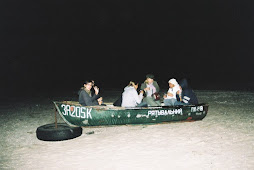
From drinking vodka while sitting in a small wooden boat on a beach to numerous restaurant visits, from one of the strangest nightclubs I have ever seen to encountering Peter, a crazy student, destined to be a dictator in later life. ("No, no, no!").
If I had to think of a single highlight of my time in Berdyansk, it would have to be the afternoon that myself and a handful of volunteers and students took a ride on an inflatable banana boat.
This basically involved being pulled across the Sea of Azov (the shallowest sea in the world, fact fans) by a speed boat. We skimmed the sea at break neck speed, before being thrown off.
In total we were thrown off three times.
It was exhilarating and scary as hell, but it was also very wonderful and very funny, and I loved every minute of it. How sad I feel now writing these words, now that those moments are memories, and those people have become a part of my past.
Last Kiss
On Saturday I boarded a train to Kiev, leaving Berdyansk behind.
I shared a compartment with Davide, an Italian boy who was leaving the same day. How glad I was for the company, as it saved me the loneliness of a 17 hour train ride to the capital. We ate potato together and passed our time speaking, smiling and sleeping.
On Sunday we arrived at our destination and I was met at the train station by Emily who was joining me in Kiev for two days. At the station I said goodbye to Davide and came close to shedding a tear, spared only by the dim hope that one day we will meet again.
Shortly after Davide left, Emily and I were met by a Ukrainian woman. She was the landlady of a flat I was renting for our time in the capital. She showed us to the flat and left me to take my first hot shower in over two weeks and to go to the toilet alone in peace. My return to civilisation was complete when I plonked myself in front of the TV and watched a few minutes of BBC World.
Emily and I spent the next two days exploring Kiev together. The city was very different than I had imagined. Very westernised, almost like a European city, and nothing like Minsk, it's Soviet neighbour.
Despite still being quite a closed country, the Ukraine boasts a bustling and thriving capital, both expensive and ultra cheap, with super wide streets, plenty of Soviet architecture, and plenty of shopping malls, McDonald's restaurants and Starbucks cafes.
Despite the Westernisation, I liked Kiev a great deal and enjoyed the two days I spent there.
The Ukraine is the biggest country in Europe (if you ignore Russia) and Kiev is a worthy capital. While we were in Kiev, Emily and I visited the Caves Monastery. Kiev's most famous attraction, the Caves Monastery is a labyrinth of caves and tunnels.
It was interesting enough, but when Emily had to wear a head dress to get inside, and when we saw the body of a child wrapped in cloth and on display in a glass coffin, along with a dozen other poor souls, it reminded me of just how much I dislike religion.
Religion played a part in the invasion of Iraq (though of course oil was the main motivating factor). It also played a part in the bombing of Lebanon, where Israel concentrated a great deal of its bombing in mostly Christian areas.
Millions have died because of something that, if you look at it with an open mind, seems preposterous.
Two hundred years ago we were burning witches at the stake. Religion was created by man thousands of years ago and yet people still cling to these beliefs. I am going off the subject here, so I will save that story for another time and another blog entry.
Despite the Caves Monastery leaving an unpleasant taste in my mouth, I enjoyed Kiev, and will return.
Emily left the Ukraine on Tuesday and returned to Belarus. Before she left, we met up with Laura and Karen for a few hours and ate borsch together (a lovely beetroot soup, the national Ukrainian dish).
Now we have left the Ukraine behind. I am currently making my way to Lithuania, which I will use as a stepping stone to get to Belarus.
More adventures await me in Minsk and beyond. But nothing I experience in that mixed-up and Soviet playground will compare to my time in the Ukraine.
There will be no banana boat rides or drinking vodka while sitting in a small wooden boat. No crazy nightclub visits. No reflection groups or discussions.
My month in the Ukraine, both terrible and wonderful, is over now.
I did not take a camera with me and so did not take a single photograph. I have nothing to show that I was ever there, nothing to remind me of the people I met, nothing but memories and these rapidly fading mosquito bites.
And when these reddish souvenirs, these tiny kisses, are gone forever, my time in Berdyansk will truly be consigned to history.
The people I spent time with, and laughed with, and drank with, will, for me, remain only in my memories. I will never see those people again. We have all left for different places and different people, now that our time together is at an end, and life is moving on.
Take care all.
I will miss you.
From the memory box of a Professional Englishman.
Sunday, 3 September 2006
Crisis in the Crimea
This is an entry I thought I would never get to write.
I thought about writing this blog entry, even constructing sentences and the odd paragraph in my head, but I was certain that it would forever remain unwritten, as I was sure I would never see a computer again.
Everything you are about to read is true. It all really happened, a little over five days ago.
My story begins at 7pm on Monday 28th August 2006. I was walking across a path leading through the hills and cliffs of Balaklava, a small town in the Crimea in the Ukraine, bordering the Black Sea.
I arrived in the Ukraine on Tuesday 22nd. The same day that I flew in, a severe thunderstorm gripped parts of the country and brought down a Russian airliner near the Ukrainian city of Donetsk.
All 170 people on board were killed.
I considered this to be a near miss. My own flight from Riga in Latvia to Simferopol in the Crimea was delayed for some hoursdue to a 'technical difficulty' and earlier in the day a plane crashed just a few hours from my destination. A lucky escape, I thought.
But my real lucky escape was yet to come.
So, I was walking across this path, admiring the view, picking my nose and minding my own business, when I slipped, fell off the path and landed on a ledge about seven foot below.
I dusted myself off, wiped the snot from my cheek and thought about climbing back up to the path. But it would have been difficult.
The way down looked easier, so I decided to climb down instead. It was my plan to make my way down to the ocean, change into the swimming trunks I was carrying in my backpack, place my clothes in my bag and swim around the cliffs until I made it to a nearby beach.
With this in mind I began my descent.
After about ten minutes of climbing, I realised that it was going to be more difficult than I had thought. What had started off as a steep slope was rapidly becoming a cliff face and many of the rocks I was using as footholds were loose.
There were two moments as I climbed that I was paralysed with fear. I was holding onto the rock and simply couldn't find anywhere to put my feet. I was afraid that my next move would send me tumbling down into oblivion. Going back up was now going to be extremely difficult, and I figured I didn't have far to go, so I continued my perilous descent.
Two hours later I was still climbing. And now it was beginning to get dark. I got to the point where I couldn't climb anymore and so I came to a stop on a ledge next to a small branch jutting out of the rock.
I realised then that I was stuck. I was stuck on a cliff in the Crimea and nobody knew I was there. Then I remembered that I was carrying my mobile phone in my backpack.
Unfortunately, I had no credit, and couldn't connect to anyone, either in the UK or the Ukraine, other than the Ukrainian emergency services. Worse still, no one could connect to me either.
After being put on hold and being forced and listen to awful Ukrainian music, which I thought would be the last music I ever heard, I got through to a woman who spoke English relatively well.
I explained my predicament, but she was having difficulty understanding the meaning of the word "cliff" and when she asked me where I was, all I could say was I was on a cliff in Balaklava, and there are dozens, perhaps hundreds of cliffs in Balaklava.
I convinced her to call Emily in Belarus. Emily had been with me in the Crimea until Sunday. I was able to pass details of my location to Emily via this woman. Convinced I would now be saved, I settled down beneath my little tree and waited for morning.
Around about midnight I watched as a storm began to form miles out to sea. Two sheets of lightning lit up the night sky. One, to my right, forked across the sky while the other, directly ahead of me, was a simple, single bolt which kept striking the sea.
The thunder, which had began as a low rumble, steadily grew louder, and I realised that the storm was headed right for me. Worse than that, the bizarre bolt of lightning was headed right for me too.
All I could do was wait.
The first drops of rain hit me an hour later. By 2am the storm was right above me. I found myself in the eyes of a storm like no other I had ever witnessed.
My little branch and I bore the full brunt of Nature's rage. This was an ocean storm, born from the Black Sea, and I was hanging onto a cliff beneath a branch directly in its path.
For more than two hours I crouched there, drenched in sweat and rain water, a soaked towel covering my head, as the storm lashed the rocks around me.
The wind and rain began to loosen the rocks and every so often one would break free from the cliff and whizz past me before falling into the sea. The worst thing was that although the lightning was illuminating the cliff face every couple of seconds, I couldn't see the rocks. But I knew they were close.
There was one, that came within about fifteen feet of me, that must have been huge, because even over the storm I heard it come booming down the cliff, break in two and go crashing into the sea.
The cliffs in the Crimea are the most unstable I have ever seen. Erosion to the extreme. And the storm was weakening the cliff face ever more.
By about 4am the storm had began to move off towards Balaklava. It seemed that my prayers had been answered. I had not been fried and my little tree had not burst into flames. The closest that strange bolt of lightening had come to me was about 60 feet.
That might seem like quite a distance, but it was enough for me to be blinded for a second, a bolt of blue seared across my mind, and enough for me to shout "Fuck!" at the top of my lungs!
So, I was thanking my lucky stars that I had not been barbecued, when shortly before 5am I watched in disbelief as another storm began to form a few miles out to sea.
I cursed my rotten luck.
With the exception of the storm that had brought down the Russian airliner a week earlier, there had been nothing but clear skys and calm seas for the past seven days. Now on the day I become acquainted with my little tree, Mother Nature decides to vent her fury.
I prayed that daylight would come before Storm No.2 made land. This was not to be. Fortunately however, the second time round it was not so bad. There was little thunder and the lightning was not quite so awful.
At about 6am the first signs of daylight started to poke through the clouds. I thanked the Lord for that.
Then at about 6.30am it started to rain. And rain. I tucked my t-shirt away in my backpack in a vain attempt to keep it dry and sat there, bare chested, as the Lord emptied His bladder upon me.
To get a feeling of what this was like, imagine taking a cold shower. For two hours. Now imagine that cold shower is on the edge of a cliff.
Eventually the rain stopped, but not before it had clouded over, and the lightning had made a very brief reappearance. Just to let me know it was still around.
By 10am on Tuesday morning the rocks (and my jeans) had almost dried off and I was ready to consider my options. Looking around, I was startled to see that beyond my branch was a sheer drop of about two hundred feet to the ocean below.
I understand that when people tell stories, especially death-defying stories, there is a temptation to embellish or exaggerate. But it is no exaggeration to say that I really was just a few foot away from being dashed to pieces and sprinkled over the Black Sea.
During the night I had taken some comfort from the fact that my little branch had some foliage attached which I took as a sign it had not been struck by lightning. Looking at it in the daytime, I realised that the inside of the bark was almost completely burnt out.
My branch had been hit by lightning. Quite recently.
To add insult to injury, the branch had since become home to an ants nest, and the ants were just waking up, and coming out to inspect this stranger who had taken up residence on their patio.
By 10.30am I had convinced myself I was not going to be rescued. Was anyone even looking for me? I had not received any texts and nobody could phone me because I could not receive calls.
So, I called the Ukrainian emergency services again and got through to an obnoxious young woman. After explaining my predicament to her, she offered to put me through to the police in Balaklava.
But the police in Balaklava do not speak English. Of that I was sure. So I asked her to pass on a message to them. She thanked me for calling and abruptly hung up. I called again. She hung up. And again. She hung up. I couldn't believe it.
The bitch left me to die.
So, at 10.35am I began climbing back up the way I had came. I tied my towel to my little tree, to give me something to cling on to in case I came sliding back down and missed my branch. Slowly, and ever so cautiously, I began my ascent, climbing parallel to the branch.
It was terrifying. Absolutely terrifying.
If I fell and couldn't grab that tree, I was dead. My throat was dry. I would have been perspiring but I had nothing left to perspire.
After an hour, I realised I could climb no further. The rocks were too loose. I put my foot on one boulder, about half my size, to test it, only for it to break free, covering my face in dust, and tumble down the cliff, splitting in two, missing my little tree by about a foot.
I was clinging onto the cliff, considering my next move, when I felt a single drop of rain on my forehead. I turned to face the sea and what I saw filled me with dread.
There, coming towards me, was a wall of rain. I had perhaps a minute before it hit land and I was washed away. I had no time to get back to my little tree. To my right was a narrow shelf in the rock with a stone jutting out beneath it. There was no time to test it. I made the decision to leap and grab the rock.
If it was loose, like so many others, I would plunge to my death. I jumped. The rock held. I pulled myself into the shelf and moments later the rain hit.
I got completely drenched. That was the very worst moment for me. Lying there, on that narrow shelf, in a puddle of water. I was up so high and all I could see was ocean. It was a very depressing moment.
I lay there for half an hour until the rain came to a stop and then lay there a while longer to give the rocks a little time to dry. Then I made my way back down to my little tree.
By this time it was midday on Tuesday and the sun made its first appearance of the day. I decided that the best course of action for me to take was to simply wait for a boat to pass.
I was too high to be seen, but had found the remains of an old beer bottle, and planned to use it to reflect the suns rays and catch someones attention. On any given day, dozens of boats passed this cliff, taking eager Ukrainians to the beach.
So I watched. And waited.
That's when the wind, which had been quite strong up until then, really picked up. It started blowing a gale. The Black Sea, which until that day had been this peaceful, serene and beautiful thing, became a raging monster. The biggest waves I have seen crashed into the cliff below me with terrifying ferocity.
The ants retreated. My little tree shook and swayed. I held on for dear life. The hours passed and I didn't see a single boat. Not one. The sea was just too damn rough, even for fishing boats.
By four o'clock in the afternoon I was starting to feel the effects of dehydration. I was dreaming of shashlik (a Georgian invention, meat on a stick. Love it) and a cold glass of Diet Coke.
All the while this was going on, my bodily functions were going into overdrive. I was burping and farting away. I thought it quite bizarre that my organs were continuing to function normally, blissfully unaware that they might soon be littering the cliffs of the Crimea.
I needed to open my bowels in a big way. It had been 30 hours since my last meal, and it wanted out. With one hand clutching the tree, I did my business, instinctively attempting to look around to make sure no one was watching. Funny, because if somebody had been watching, it would have been wonderful!
By the time I was finished, the sturgeon I had eaten a day earlier proceeded to roll off the ledge and returned to whence it came.
By this point I had accepted that it was more likely that I would die on this cliff than be rescued. I started to think about the futility of my situation and how stupid I had been. I didn't want to die here, in this lonely spot, only to be found months or years later, an old skeleton wearing Versace jeans.
I thought about jumping from the cliff. I thought that perhaps I could escape with a few broken bones. Looking back now, in the cold light of day, I realise that I would not simply have broken a few bones. It was more likely that my spine would have been ripped out or my head cracked open as I bounced from rock to rock.
Another option was simply to stay there, next to my little tree, and allow myself to die of thirst. As the hours went by, that seemed like an ever more appealing option.
Instead, I decided to set my sights on a ledge about thirty foot above me. It was wider than my ledge. I had even seen some grass on it. It was the penthouse of ledges compared to my bedsit ledge. The ledge became the Promised Land and I set my sights on reaching it once the gale had died down.
I continued to take shelter beneath my little tree when, quite suddenly, I was jolted out of my thoughts by the sound of a man calling my name. I looked up and saw three concerned faces, looking down at me from my penthouse ledge.
The name of the man who rescued me was Dima.
He brought fifteen colleagues with him. It would have been impossible for me to remember all their names, and so I resolved to remember just one, the name of the man who reached me first.
My rescuers were all very kind, very polite and very professional, despite carrying old, Soviet equipment with them. They came down from an angle, so as not to send rocks crashing my way.
A safety belt was tied to my waist. A helmet was shoved on my head. I was given a piece of rope to cling to. And then Dima and I and two of his colleagues all climbed the cliff together.
As we made our way to the top, rocks continued to break free, plunging into the ocean below. I understood then that had I not been rescued I would have died on that cliff. I would not have made it back to the top. The rocks were too loose, the cliff too steep.
I would have joined the boulders and remains of the sturgeon I had eaten a day earlier at the bottom of the Black Sea.
After giving me water and coffee, my rescue team took me to a local fire station (with two fantastic Soviet fire trucks outside) and I was given a bed. Everyone was very nice. They all wanted to shake my hand, they took lots of photos and someone even produced a video camera.
On the walls of the fire station were two pictures of a forest and one poster of a little girl holding a dog. I remember thinking how nice that was. Visit any fire station in the UK and all you'd see is tits and arses.
After a short rest and about fifteen minutes of saying thank you, I was driven back to my hostel by one of the firemen.
Once there I had a wonderful hot shower. It was incredible, the best I have had. I attempted to wash the stones, dust, dirt and crap from my hair. After that I was given a meal by one of the women who works at the hostel. It consisted of a boiled egg, a piece of bread topped with ham, and a tomato. Shortly afterwards, Emily's Aunt visited me and brought me some bread rolls.
A little later, after telephoning my Mum and Emily, I visited a local restaurant where I was finally able to live my dream - I ordered hot shashlik and an ice cold glass of Diet Coke.
Then it was back to the hostel. By 11pm on Tuesday night I was exhausted, I had aches in places where I didn't know I had places, and it was time for me to sleep, which I did, for about eleven hours.
I found out the next day that a Ukrainian rescue team began looking for me at 8pm on Monday evening.
The search was later abandoned due to the storm, which was so bad that it had uprooted trees. Early the next morning the search began again and two more rescue teams joined in.
Emily had spent the night worrying and crying. She had called my Mother and she too, along with my sister, had spent the night worrying and crying. Emily also contacted her Mother and her Aunt in the Crimea and they spent the night worrying and crying, along with Emily's uncle, who spent the night worrying but not crying.
A great deal of pressure was put on the Ukrainian emergency services, and this was why so many teams joined the search, and perhaps why it had only taken about 24 hours to find me.
Today I am a very minor local celebrity.
There is a story about me in the local paper. They spelt my name wrong and they have written that I fell 30 metres, but still, the bulk of the story is true.
Now that the experience is over and I have escaped almost unscathed, I do not regret that it happened. (I say almost unscathed, because this morning I woke up with two very long white hairs on my head. I hope this is not a sign of things to come).
What happened on that cliff has given me a benchmark, an experience so awful that I can compare it to lesser events in my life and suddenly they don't seem so bad.
I often have problems with people. Shortly before I came here, I had my mail stolen in the UK and I was threatened, but it all pales into comparison next to the 24 hours I spent on that cliff.
The Englishman Who Fell Down a Hill and Found A Mountain.
A few hours ago I returned close to the spot where I spent my 24 hours in hell. It was important for me to return. Venturing down a little, I was even able to make out my branch, way down below.
So, on my very last day in Balaklava, I leave here a little stronger. I also leave a towel, tied to a branch, on a ledge, on a cliff in the Crimea, not far from where I write to you now.
Take care. And thanks for reading this.
Tuesday, 28 December 2004
No Joy in Jericho
So the craziness that is my life continues...
This entry comes to you from a little Internet cafe in what is without a doubt the maddest, most fascinating, incredible and most jaw-dropping place I have ever step foot in...Palestine.
In all of my travels, in all of the places I have seen and the people I have met, in all the things I have done, I have never experienced anything quite like the Middle East.
This is truly a fly-by-the-seat-of-your-pants visit; I have no idea what is going to happen from one moment to the next. Danger is ever present, things are out of control and unpredictable.
Palestine is an insane place of checkpoints, conflict, persecution, anger, religion, poverty and some of the friendliest people I have met. I doubt whether there is anywhere like this on the planet.
I arrived in the Middle East two weeks ago. I flew from London, with an 8 hour break in Budapest, which gave me a chance to explore the city, and arrived in Tel Aviv in the early hours of Thursday morning.
After leaving the airport I grabbed a 'sherut' - a local minibus - and headed to the Fascial hostel in Jerusalem, where I slept for about eight hours, before making my way to Jericho in Palestine.
I am here with a large group of international volunteers to learn more about Palestine, and the conflict, and to help the local farmers and let the Palestinian people know that they are not alone.
These past weeks have proved to be interesting and educational. I'm having problems in my private life at the moment which has made being here difficult but nonetheless when the pain has eased and I remember this visit, I will look back with wonder.
After spending so many months in Belarus, a country most people have never heard of, it's interesting to be in a part of the world that continues to dominate TV news shows and the front pages of newspapers all over the world.
Myself and the volunteers have divided our time between helping the local farmers in their fields, gathering fruit and vegetables, and visiting places of interest in Palestine.
Today we returned from the Dead Sea where we spent a few hours floating on the water, covering ourselves in mud and getting salt in our eyes. A few days ago I returned from Ramallah where I had a chance to visit the resting place of Yasser Arafat.
Later we had a meeting with Saab Erekat, a well known Palestinian negotiator. He was an interesting and an intelligent man and I hung on his every word.
On Christmas Eve we headed to Bethlehem where I was lucky enough to be able to enter the Church of the Nativity. We had tickets for the midnight mass. As much as I hate to say this, I didn't stay for the service. I headed back to my hotel before midnight.
That may be something I regret in years to come. I was in the Church of the Nativity, in Bethlehem, on Christmas Eve, and I didn't stay for the service? But I had other things on my mind (the problems I mentioned earlier) and it was difficult for me to think of or do anything else.
I did get the chance to visit the spot where Christ was apparently born. However, as I have serious doubts about Christ and who he was or whether he actually existed at all, I can't say that I was particularly moved or affected by the experience.
I think the highlight of these two weeks has been simply meeting and getting to know the Palestinian people. They are a very brave, warm, humble and friendly people. They are suffering a great deal, yet they still manage to smile, even when all hope seems lost.
Before I came here, I knew a little about the Israel / Palestine conflict. What I have discovered during these past weeks has shocked me. My disgust towards Israel - and as ever America - increases daily.
The persecution of the Palestinian people is a crime and one that the world continues to overlook. The West takes an interest when suicide bombers blow themselves up in Israel, yet these bombs are a response to Israel's crimes and occupation.
Call these young men and women terrorists, but also realise that Israel is a terrorist state and one that murders people every day. In just the past few days alone around twenty Palestinians have been murdered by Israeli soldiers.
But this is not just about the death count. This is about the daily persecution and harassment of the Palestinian people; from the humiliating checkpoints they have to pass through every day, to the massive wall that is being built around Jerusalem.
A few days ago I visited refugee camps in Bethlehem and Jericho. I met some wonderful kids living there. They showed me around the remains of a house which had been demolished by the Israeli army.
It was heartbreaking to be shown around this house as the children described, in broken English, and in a matter of fact way, how Israeli soldiers had come in the dead of night and ordered the family to leave before lobbing grenades into the house.
No child should ever have to see this or tell a story like that. And yet this is a story that will be repeated until the dream of a Palestinian state is finally realised.
Indeed, being here in Palestine has been an education for me. I leave with a head full of memories and a heart full of emotions.
Certain events replay themselves over in my mind, like working in a farm in the early hours of a sunny morning and hearing the echo of distant gunfire as the Israeli army practised in the surrounding hills.
Or walking through a checkpoint late at night, guns aimed at me, as Israeli soldiers barked orders at me and I tried desperately to understand what they were saying.
Or driving a tractor for the first time. Or touching a camel. Or being treated like a celebrity by friendly and curious children.
Despite my inner pain, which has dominated my every waking moment, these have been a wonderful two weeks and I will miss these people and will return to Palestine again.
Tomorrow I leave Jericho and head to Jerusalem where I will enter Damascus gate and explore the Old City.
Then at 6am on Thursday I head to Tel Aviv for a flight that will take me to London via Budapest (where I have a gruelling 8 hour wait for my connection). I must then catch a bus that will take me to my Mother's house where I will arrive at 7am on Friday morning.
I spend three days with my Mother before returning to London and then catching a flight to Poland on the 5th of January. From Poland I travel to Minsk in Belarus for what will be my eleventh visit.
But before I do any of that, I must bring this entry to an end. I would like to say goodbye to all of the wonderful people I have met here, especially all of the Palestinian volunteers, and to Andrew, Tim, Karen, Miki, Meg, Martina, Hisham, Kristina and Hasan.
This is an Englishman, in Jericho, wishing you peace...
From the memory box of a Professional Englishman.
Tuesday, 23 November 2004
Back in the USSR
A few days ago I found my brother David living in an orphanage in Belarus.
I didn't expect to find him there. It came like a bolt out of the blue, something that I could never have anticipated, and it upset me a great deal. For the first time in over a year and a half I had to fight to hold back the tears.
I was visiting an orphanage in Minsk - where I've worked with children with mental and physical disabilities for over a year - when I met a little boy called Artur, twelve years old, who reminded me so much of my brother David, it was uncanny.
He looked like David, he had the same mannerisms and gestures. David, who is now 22, has not spoken to me for some years. He ignores my calls and my letters go unanswered. David had a very difficult childhood and my Mother often mistreated him or did not give him the affection and love that every child needs.
I too picked up on this and was unkind to David, not as a brother should be, which is probably the single biggest regret of my life.
As a result, David has grown up angry. He has a chip on his shoulder. He has no contact with me or my Mother. He is very much alone.
Meeting this little boy, dressed in old clothes and torn slippers, who tried to impress me with his break dancing, really brought home to me the plight of these children. At the same time it brought back memories of David and for some minutes I was overcome.
It's rare for me to get so upset. Normally I enjoy visiting the orphanage and I have a lot of fun with the kids. I've known most of them for a year, we've forged a bond, and I've come to care about them and I believe that they care about me too.
These kids, and my dear Emily, are two of the things that bring me back to this crazy Soviet republic; a land of milk in bags, speeding metros and general all-round craziness.
I arrived in Belarus almost one month ago after spending a wonderful 2 weeks in Poland. This is my 10th visit. I will leave here tomorrow and head back to Warsaw for a few days before returning to the UK on Saturday, where I will recharge my batteries for two weeks and then hopefully set off on my travels again.
It has been snowing heavily in Belarus these past few days. Minsk looks very pretty today, covered in a blanket of white. Despite plummeting temperatures - a couple of night ago it was six below zero - it's nice to be back here in this wintry wonderland.
Belarus is indeed a strange and incredible place. It has changed little since the collapse of the Soviet Union and is full of old Soviet lorries and statues of Communist heroes.
Many Belorussian people - including Emily, who is only 27 - look back on the Soviet period as a golden era, when life was simpler and problems were few. Lukashenko takes advantage of this nostalgia, which has probably helped him to remain in power for so long.
The Belorussian people themselves are very nice, very hospitable and very friendly. They are always kind to me, and Emily has as ever been simply wonderful. But there is a lack of common sense here, an absence of logic, that often irritates the hell out of me and sometimes just drives me mad.
Take today for example. I was walking down the main high street in Minsk, picking my nose, minding my own business, when I turned round to see a tractor rapidly approaching me. On the pavement.
The driver made no attempt to slow down, he was too busy concentrating on the snow that he was meant to be clearing. I moved to let him pass and watched, in amazement, as children went running for cover and elderly women dived out of his way.
The crazy thing is that at the time it was snowing heavily, and less than an hour later the pavement was once again deep with snow. (Maybe next time they'll use two tractors?)
This is just one example of the craziness of this country. I've given many more examples in my other entries from Belarus. Common sense still hasn't been able to get a visa for this country.
But if you can learn to live with - or at least tolerate - the killer tractors, the milk in bags, the speeding drivers, the speeding metros and the bowel busting food, it's possible to have a very nice time here, simply because the people are so wonderful, and unlike any I have met before.
I've noticed that my life kind of grinds to a halt while I'm in Belarus. When I visit other countries I get out a lot and visit new places.
But here my life revolves around Emily, Patio Pizza (my favourite restaurant in the world, and one of only a handful of good restaurants in Belarus) and visiting the kids in the orphanage.
Still, I do enjoy my time here, and I will at some point return to Belarus, though I have no idea when. For now there are other places to see, other people to meet, and it's time once again to leave this wintry wonderland behind and head to pastures new.
I will write to you again as my travels continue.
Until then, it's time to say goodbye to Minsk, goodbye to my angel Emily, to Artur and all of the children I know and love here.
This is an Englishman, leaving the USSR, wishing you well.
Take care Belarus. Take care Emily. Take care David.
From the memory box of a Professional Englishman.
P.S. Emily has asked me to make it clear that she in no way shares my opinion about the craziness of this country. She doesn't believe it's crazy at all. Which only goes to prove my point...!
Thursday, 28 October 2004
The Children of Chudobczyce
Last Monday I travelled backwards in time.
I slipped through a crevice in the space-time continuum and found myself in a long forgotten place inhabited by long forgotten people.
A place called Chudobczyce...
On Saturday I left behind the comfort of Nathan's Villa and the hustle and bustle of Warsaw and travelled to a small city called Poznan.
Poznan is a beautiful city. My guide for the two days I was there was a Polish girl called Dominika. On Monday I left Poznan and boarded my time-machine - in this case a small Polish bus - and began to make my way through the villages and countryside of Poland.
Civilisation fell away...my watch began spinning wildly in the wrong direction...the crows feet around these blue eyes began to fade...memories cartwheeled through my mind and a multitude of faces danced their way across my brain as the bus wound its way down winding roads and past wizened trees.
Eventually the bus came to a stop and I got off, backpack in tow. A German girl came bounding up to me. "Are you Andrew?" she enquired. I replied that I was, because anything else would have been a lie. My journey was at an end. I had arrived in Chudobczyce...
Chudobczyce is a small village with a population of about 170. Life has changed little since the collapse of Communism, or indeed since the collapse of the Roman Empire. Cars and mobile phones, and indeed Englishmen, are not a common sight here.
Chudobczyce is home to a project called Barka, which helps recovering alcoholics and homeless people. It's also home to a Spanish girl called Berta, her boyfriend Mariusz (who I like immensely) and Linda, the German girl who met me at the bus stop.
Berta has dedicated the last year and a half of her life to helping the children of Chudobczyce...a noble task, giving up all of the luxuries that we take for granted to help the children of a forgotten village.
I like these kids. They're sweet. I've spent the last days playing and chasing them - or being chased by them - and I think (or hope) I've managed to connect with many of the youngsters.
Shortly after my arrival on Monday I went to explore a nearby forest, where I promptly got lost. I had visions of being eaten by a bear (a rabid bear recently attacked and killed two people in Romania) and it was up to the children and Linda and Berta to come to my rescue.
But that and one other incident aside, I've really enjoyed my three days in this funny little place.
I came here to meet the children, and Linda and Berta, and to decide if I want to return here early next year. But as much as I've enjoyed these last three days, there's one thing that I hate about Chudobczyce, one thing that I truly despise: the flies.
Chudobczyce is home to millions, possibly billions, of these big, black, buzzing creatures. And they're adventurous little things - they like to explore your soup, your hair, the odd nostril and one or two other orifices - but we won't go into that (or them) here.
On my first night I discovered dozens of the little monsters living around the window in my room so I decided to zap them with a can of Raid. Big mistake.
It was like something out of a Stephen King novel. They started attacking me and dive bombing everything in sight, including my head, so I got out of there pretty sharpish, taking my mattress with me, and set up camp in the kitchen.
But the flies followed me and were soon dive bombing me in the kitchen. Enough was enough, I was not lord of the flies. I retreated outside of the my room and slept in the hallway, where I was awoken some hours later by a drunk man who was kicking me in the head.
But as I wrote, imaginery bears and flies aside, I have really enjoyed my time in this long forgotten place and I hope one day to return. I'll just remember to bring a bigger can of Raid...
And now it's time to board my time machine and head back to civilisation. My bus leaves in an hour from now. It will take me back to Poznan where I will board a train for Warsaw. Once I'm in Warsaw I will catch a train that will again take me backwards in time to the long forgotten country of Belarus.
Until my next entry, from within the USSR, it's time for me to say goodbye to Dominika, Berta, Mariusz, the children and the flies, and time for me to prepare for the long journey ahead.
Goodbye from Chudobczyce...
Back to Civilisation.
From the memory box of a Professional Englishman.
Subscribe to:
Posts (Atom)
About Me

- Professional Englishman
- London, ENGLAND, United Kingdom
- This is me. Read a few entries and they will tell you more about me than I can fit into these few paragraphs. Many of these entries started their lives as mass emails. That was before I discovered blogs. Thanks for stopping by and thanks for visiting my blog and reading about my life. Both a work in progress.